Showing posts with label vocabulary. Show all posts

Saturday, 28 January 2012

The Costa Concordia disaster

At least 16 people died in the unfortunate incident of a luxurious cruise ship in Italy on Friday, 13th January 2012. The news has been full of stories about the captain, the circumstances of the accident, the rescue operation and the survivors. It can be a good topic for English lessons because everybody heard something about it. 
I also discussed it with my students and I prepared some tasks for them.


After clarifying the basic vocabulary related to the topic, we listened to a text describing the events:
 Costa Concordia disaster mp3

You can see the script here: Listening script in PDF


Topic related vocabulary: 
nouns: lifeboat, manslaughter, house arrest, cruise, crew, passenger, evacuation, island, fuel, hull
verbs: to tilt, to hit, to blame, to rescue, to survive, to flee

We also analyzed some illustrations:

The route of the ship after the collision

The Island of Giglio and the ship at the bottom of the picture taken from a sattelite

Italian people wear T-shirts with a quote from the coast guard talking to the captain: "Get back on board! Damn it!"


The previous routes


Thursday, 26 January 2012

Do you know why English has different names for animals and their meat?

I'm sure everybody knows the famous beef steak? But why is it called beef if the animal it comes from is the cow?


The story goes back to old times. When in 1066, following the battle of Hastings, William the Conqueror began to rule England along with Normandy, most of the aristocracy became Norman (French).

The Norman Flag

The Battle of Hastings 1066 on the Bayeux Tapestry

William the Conqueror

The peasants on the fields spoke old English but the landlords and their chefs in the castles spoke French.

Therefore in the field an animal had an English name but once it got to the kitchen the French name was used.

Norman castle in Portchester, England

Over time, these words passed on to regular people as ingredients used by the royal chefs.
The words have changed a little but you can still see their French origin:

beef – Old French: boef (ox)
pork – Old French: porc, from latin: porcus (pig)
venison – Old French: venaison (meat of large game, boar or deer, in French it means "to hunt")
mutton – Old French: mouton (sheep)
veal - French: veau (calf)

The word "bacon" also comes from French: cured pig's meat.


 Apart from the original farm animals, the ones coming later have still the same animal and meat names, such as turkey etc.

Match the meat names with the pictures. 

venison (2), beef, hen, duck, pork, veal, mutton, turkey, lamb, goose


Thursday, 24 November 2011

Guy Fawkes Night

History

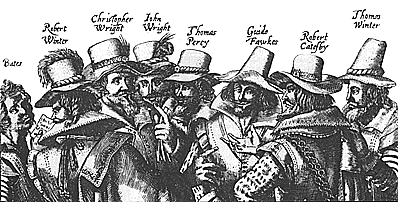
                                                                The conspirators

The Gunpowder Plot is the name given to the conspiracy to blow up the Houses of Parliament on 5th November 1605, which was discovered the night before. The plot centred around five conspirators, among them Guy (or Guido) Fawkes. 

                                                                   Guy Fawkes 

They were determined to blow up the House of Lords in 1605. The detonation was to take place on State Opening day, when the King, Lords and Commons would all be present in the Lords Chamber.

                                                      The Houses of Parliament in old times

On the 4th November, due to an anonymous letter warning one of the MPs not to attend the event, the Parliament was searched and Fawkes was found in the cellar at midnight with the gunpowder. He was then arrested and executed for treason in the Tower of London along with the co-conspirators.

                                      Tower Hill - the execution site in the Tower of London
Tradition

The 5th November is variously called 'Firework Night', 'Bonfire Night' or 'Guy Fawkes Day'. It is still the custom for Britain on, or around, 5th November to let off fireworks and children to make guys.

                                                          Burning Guy in the Bonfire 

The Houses of Parliament are still searched by the Yeomen of the Guard just before the State Opening (normally held in November since 1928) to ensure no latter-day Fawkes is in the cellars, though this is retained as a picturesque custom rather than a serious anti-terrorist precaution.

                                                                     the Yeomen


Vocabulary
Match the vocabulary items with their definition. There is one extra word.

conspiracy, cellar, gunpowder, arrest, execute, treason, custom, fireworks, yeoman, precaution

1. an underground room often used for storing things

2. an accepted way of behaving or of doing things in a society or a community

3. (in Britain in the past) a farmer who owned and worked on his land

4. explosive powder used especially in bombs or fireworks

5. something that is done in advance in order to prevent problems or to avoid danger

6. a secret plan by a group of people to do something harmful or illegal

7. to kill somebody, especially as a legal punishment

8. the crime of doing something that could cause danger to your country, such as helping its enemies during a war

9. to be taken to a police station and kept there because the police believe they may be guilty of a crime


Questions
Answer the following questions

What is the Gunpowder Plot?

When was it revealed?

Who was Guy Fawkes?

What happened to the conspirators?

How do British People commemorate this historical event?

Monday, 25 July 2011

Summer vocabulary

Nyári szókincsfejlesztő

Párosítsd a következő kifejezéseket a megfelelő képekkel.
Van egy kifejezés, amihez nem tartozik kép, ha megtaláltad, tölts fel egy ahhoz tartozó képet a Riverside Nyelvstúdió Facebook oldalára! Riverside Nyelvstúdió Facebook
Jó szórakozást!

Match the following expressions with the pictures.
There is one extra word with no matching picture, upload a picture of this word to our Facebook site! Riverside Studio Facebook
Have fun! 


flip-flops               lilo                   swimming trunks               goggles                      parasol
watermelon           deck chair        paddle boat                     flippers 


Wednesday, 26 May 2010

Current affairs in the English classroom

I think it is a good idea to deal with news stories in a lesson. Students are usually interested in current issues, such as politics, disasters, celebrities and special events. Teachers can take advantage of their students' interest and teach them some new vocabulary. In addition, a lesson like this is certainly communicative as everybody must have an opinion about the actual happenings.

This time I prepared an exercise about the current volcano eruption.
At first students need to match the following expressions with the pictures.

FORECAST, CANCELLATIONS, ENGINE, VOLCANO, ASH, ERUPTION, GROUNDED TOURISTS, ICELAND

After naming the pictures, clarifying their meaning and pronunciation (especially: volcano = /vɒlˈkeɪnəʊ/ and eruption = /ɪˈrʌpʃn/ ) , I would ask a student to summarize the current story of the Icelandic volcano with the help of the new expressions.

Another exercise would be to match the two halves of some expressions still in connection with the eruption and its consequences.

Students would read the solutions one by one and form a sentence with each of the expressions.

Hope you like these exercises. Do you ever deal with current affairs in your lessons?